Green goddess
Botanical name
Zantedeschia aethiopica
Family
Araceae (arum)
Where is it originally from?
South Africa
What does it look like?
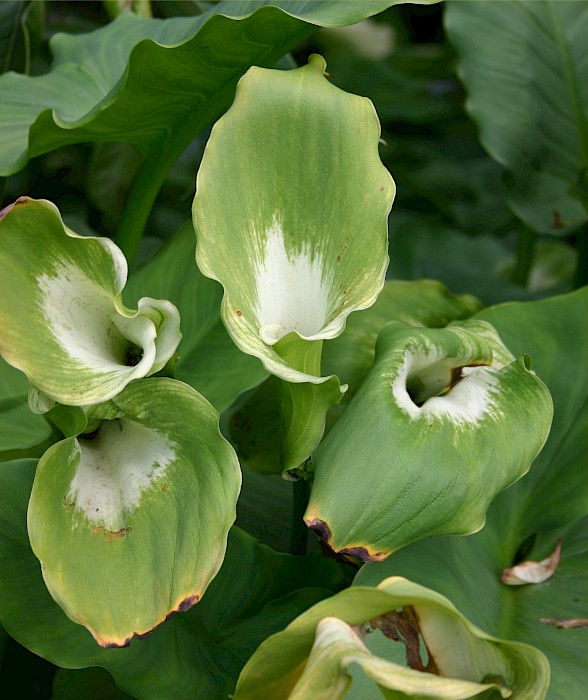
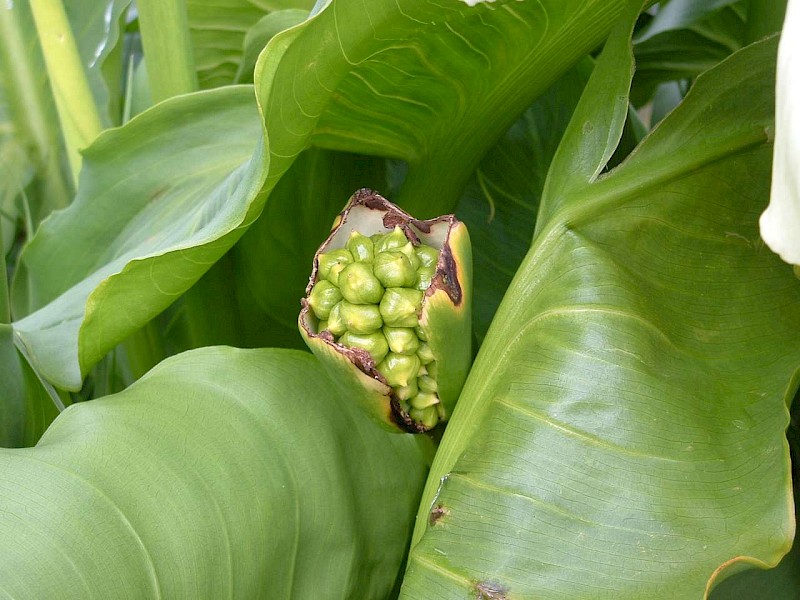
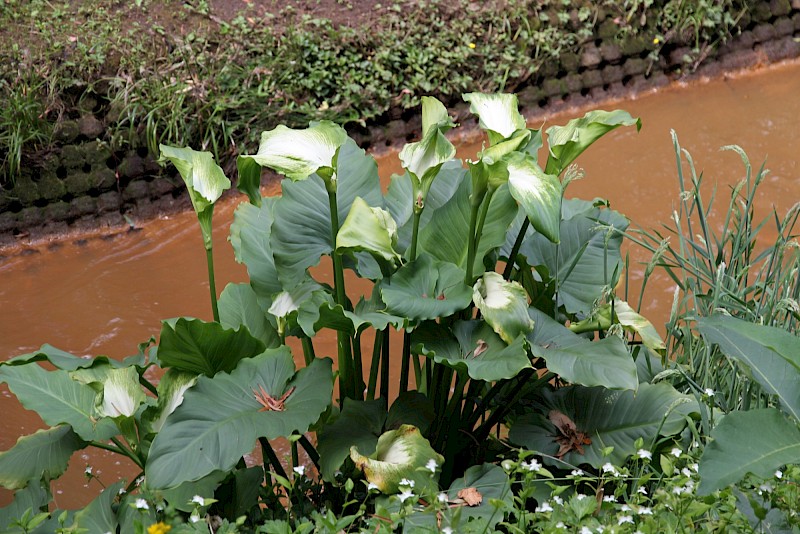
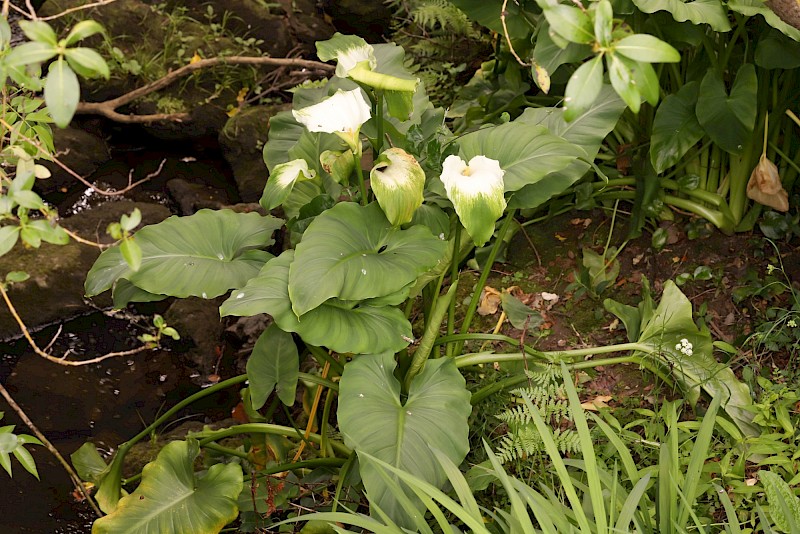
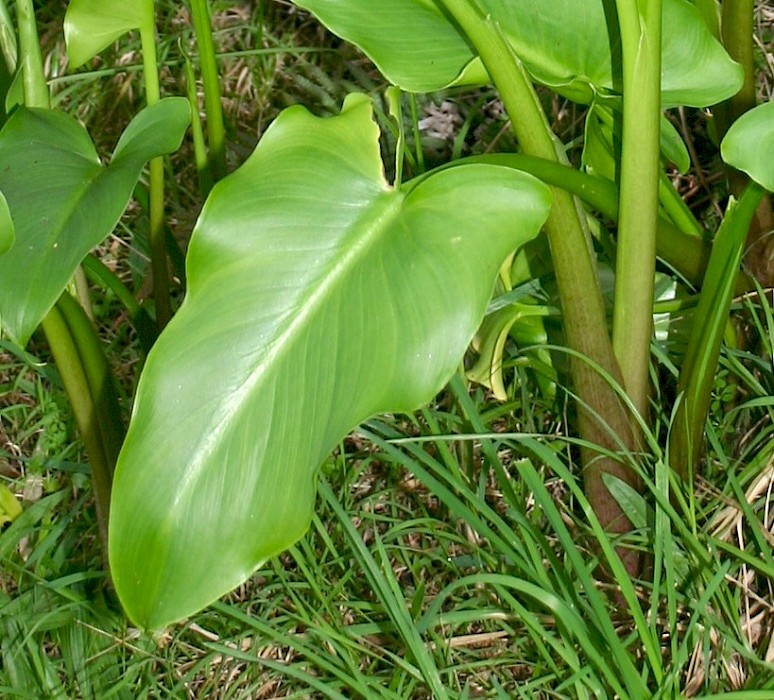
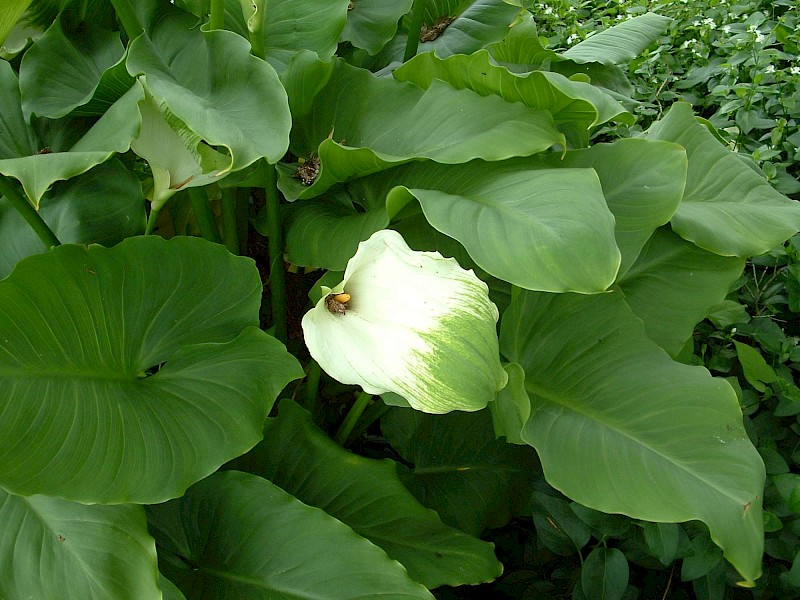
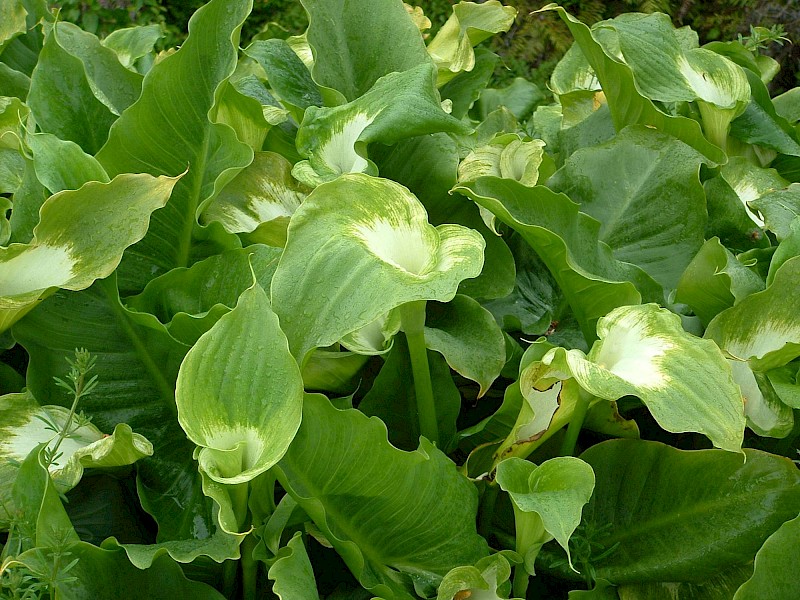
Clump-forming, evergreen perennial (<1.5 m) growing from tubers, with large glossy, leathery, dark-green, arrow-shaped leaves (to 45 cm x 25 cm) with pale fine veins and wavy margins, held upright on long stalks (<1 m). Yellow, finger-like spikes, surrounded by large, greenish-white, funnel-shaped, modified leaves (<25 cm, Sep-Dec), form a flower-like structure that is followed by round green or yellow berries (1 cm) on the flower stalk after the leaves die back.
Are there any similar species?
Italian arum (Arum italicum) is smaller and has distinctive cream-coloured markings on its leaf.
Why is it weedy?
Tolerates a wide range of conditions including wet, wind, salt, hot to cold, most soil types and moderate shade, and is drought-resistant once established.
How does it spread?
Seed is spread by birds and water, and it also spreads by fragments of tubers.
What damage does it do?
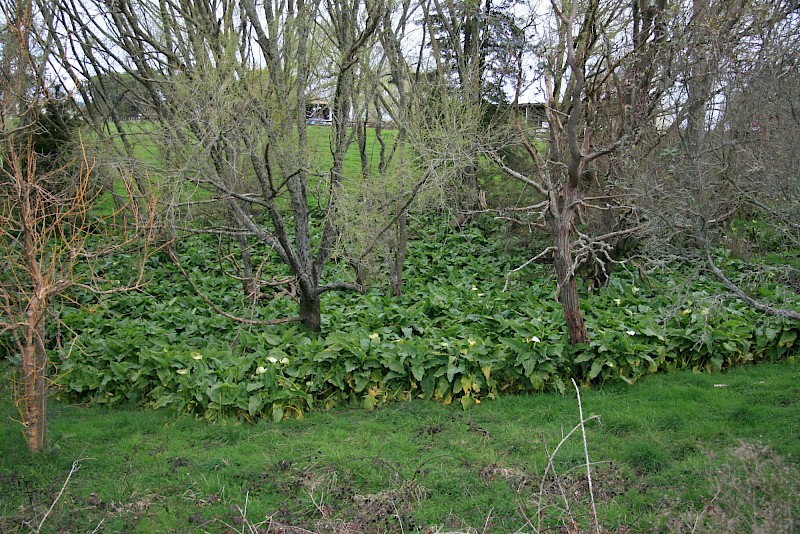
Forms dense cover on the ground in open sites, shading out native plants and preventing native plants establishing.
Which habitats is it likely to invade?
Swamps, river banks, open damp areas with high light to part shade and regenerating ex-pasture.
What can I do to get rid of it?
1. Physical removal - Hand pull or dig out entire plant - Ensure all plant material is removed from site to prevent regrowth and dispose of to a refuse transfer station. Tubers can be dried out and burnt.
2. Cut and paste - Cut the stem/trunk as close to the ground as possible and cover the entire stump with herbicide as soon as possible after cutting. Apply glyphosate OR metsulfuron gel to the entire cut stem. Dipsose of any seeds to refuse transfer station.
3. Foliar spray - Apply herbicide using a hand held sprayer/knapsack. Apply a mix of Glyphosate (360 g/L active ingredient) herbicide at 15ml/L + metsulfuron herbicide (600g/kg active ingredient) at 0.3g/L + an organo silicone penetrant such as ‘pulse’ or ‘boost’ at 3ml/L and thoroughly wet all parts of plant OR apply Metsulfuron herbicide 600g/kg active ingredient at 0.5g/L plus organosilicone penetrant at 3ml/L. . Note: Overspray will kill other (desirable) broadleaf plants and has residual activity in the soil which aids in killing below ground parts. Do not use over or near water bodies or wetlands and use only as directed on label.
CAUTION: When using any herbicide or pesticide, PLEASE READ THE LABEL THOROUGHLY to ensure that all instructions and directions for the purchase, use and storage of the product, are followed and adhered to.
What can I do to stop it coming back?
Plant a dense cover of native trees or shrubs to produce deep shade.
Images