Mysore thorn
Botanical name
Biancaea decapetala
Family
Fabaceae (pea)
Also known as
Wait-a-while
What does it look like?
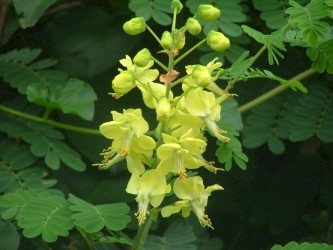
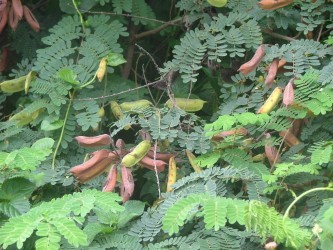
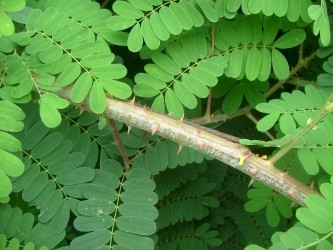
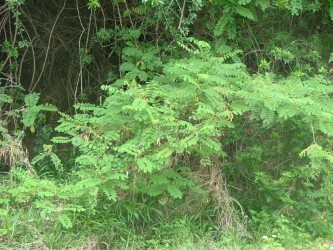
Spiny scrambling shrub (<15m tall). Young shoots finely ribbed and rounded, and stems are woody, with tapering, hooked spines where stems join with leaves, occasionally in pairs. Leaves are divided twice, first evenly into 5-10 leaflet pairs (8-20mm long) with no terminal leaflet, then into 6-12 pairs of tiny oval leaflets. Pale yellow, pea-like flowers (15 mm long) are grouped along the end of the stems (Jun-Nov), and are followed broad, oblong pods (7-10 x 2-3 cm) containing smooth, mottled brown seeds (8-10 mm long).
Why is it weedy?
Very quick growing and maturing, and produces many well-dispersed seeds. Thicket-forming, long-lived. Tolerates wind, salt, hot, drought, poor soils, moderate shade.
How does it spread?
Seeds are spread by soil and water movement and wind.
What damage does it do?
Forms impenetrable thickets, preventing native species from establishing, and killing all plants growing above and below it.
Which habitats is it likely to invade?
Disturbed forest and shrubland, fernland, open sites in coastal forest; potentially in Northland.
What can I do to get rid of it?
1. Physical removal - Dig out seedlings and small plants (all year round).
2. Cut and paste (all year round) - Cut the stem/trunk as close to the ground as possible and cover the entire stump with herbicide as soon as possible after cutting. Apply either metsulfuron gel (10g/l strength) OR picloram gel (43g/l strength) to the entire cut stem.
3. Foliar spray - Apply Metsulfuron herbicide (600g/kg active ingredient) (Knapsack 0.5g/L, or Gun and hose 20-35g/L) plus organosilicone penetrant (3ml/L) to thoroughly wet all parts of plant. Note: Metsulfuron overspray will kill other (desirable) broadleaf plants and has residual activity in the soil which aids in killing below ground parts
CAUTION: When using any herbicide or pesticide, PLEASE READ THE LABEL THOROUGHLY to ensure that all instructions and directions for the purchase, use and storage of the product, are followed and adhered to.
What can I do to stop it coming back?
Major potential pest, eliminate in all warmer areas. Follow up for 5+ years, then replant with dense shading species.
Images